What Is a Salvage Title?
A salvage title usually means an insurance company or state decided the vehicle was a total loss after major damage. That does not always mean the car is worthless, but it does change value, paperwork, and risk.
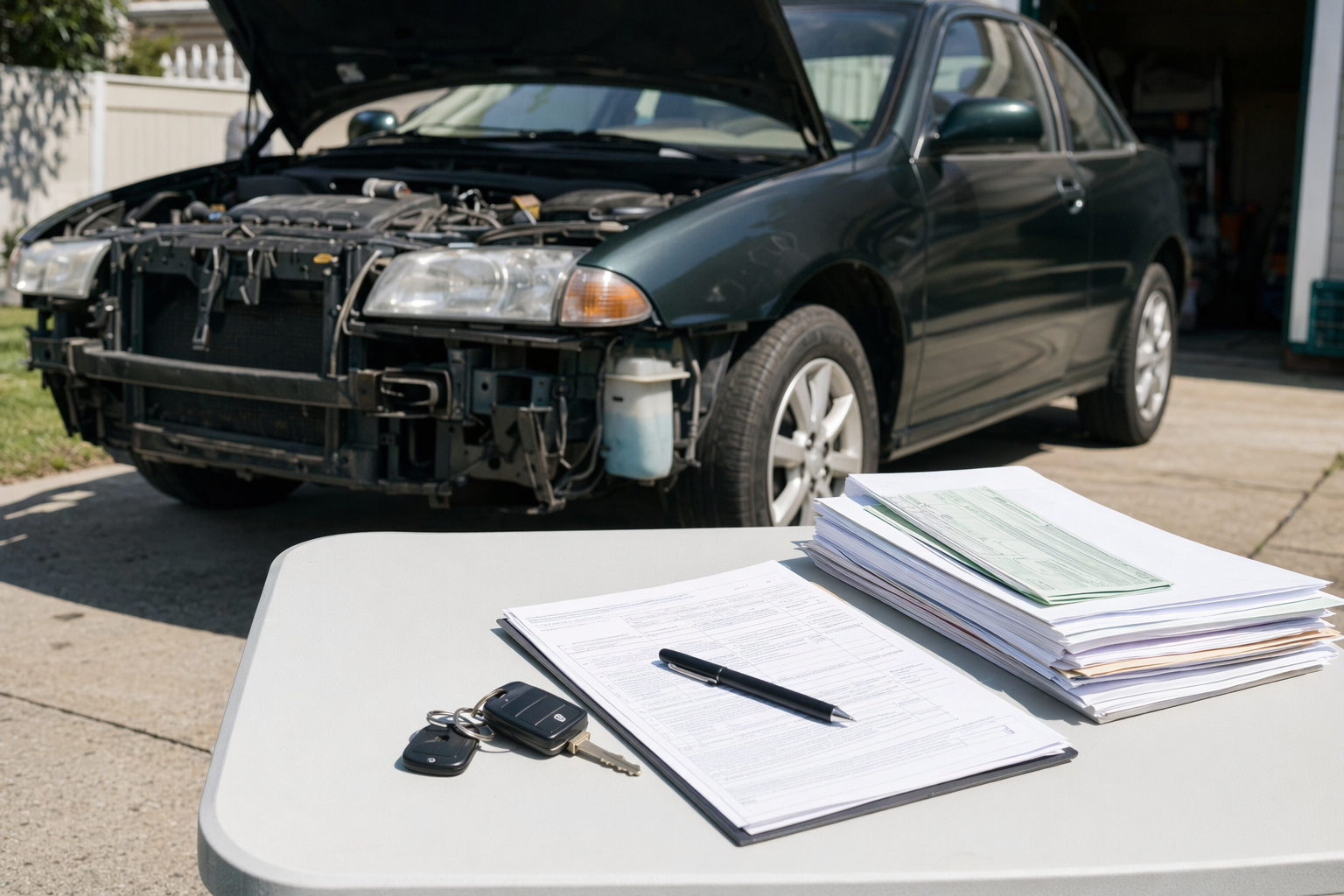
The short answer
A salvage title is a branded title used for a vehicle that had serious damage or loss. Common reasons include a bad crash, flood damage, fire, theft recovery, or another event that made repair costs high compared with the car's value.
In simple terms, the state is warning future buyers that this car had a major problem in the past. Because of that, a salvage-title car is usually worth much less than the same car with a clean title.
If you want to sell one, expect buyers to look closely at:
- the year, make, and model
- whether it runs and drives
- the type of damage
- missing parts
- local demand for parts
- current scrap metal and used-parts prices
- your location and pickup distance
Typical ranges are often lower than for a clean-title car. For example, a wrecked or flood car may land around $150-$900 as a rough estimate, while scrap-only value may be around $100-$500. Heavier trucks and SUVs may bring more by weight, often around $250-$1,200. These are not offers or guarantees. The real cash offer depends on the vehicle and market conditions.
If you are trying to understand what your vehicle may be worth before you talk to buyers, see how junk car prices work.
What salvage title usually means for value, insurance, and repairs
A salvage title matters because it changes how other people see the car.
Value: most buyers will pay less for a salvage-title vehicle. Even if it runs well now, the title brand stays with the car unless your state has a different process after inspection. A buyer may worry about hidden frame damage, electrical issues, rust from flood water, airbag problems, or expensive future repairs.
Insurance: getting full coverage can be harder, and some insurers may limit what they will cover. Rules and underwriting vary. Always ask your insurer directly.
Financing: many lenders do not like salvage-title vehicles. That can reduce your pool of private buyers.
Repairs and parts: sometimes the car is not worth fixing for the road, but it may still have value as:
- a whole non-running vehicle
- a damaged vehicle sold to a licensed buyer
- a parts vehicle
- scrap metal by weight
That is why two buyers can look at the same salvage car and come back with very different numbers. One may want the engine, transmission, doors, wheels, or catalytic converter. Another may only care about scrap weight.
If you need affordable replacement parts for another vehicle, salvage and recycled inventories can help. ScrapRoute can also help you find used parts through licensed recyclers. For big-ticket items, used engines and transmissions can sometimes cost much less than new ones. A used engine may range from a few hundred dollars to around $1,500 installed-ready, and a used transmission often falls around $300-$1,200, depending on the vehicle and setup.

Salvage title vs. rebuilt title: not the same thing
People mix these up all the time. They are related, but they are not the same.
- Salvage title: the car was declared a total loss or seriously damaged.
- Rebuilt or reconstructed title: in some states, the car was repaired, inspected, and allowed back on the road under a different branded title.
- Clean title: no major title brand shown, though that does not always mean the car never had problems.
Important: the exact words and process vary by state. Some states use different labels. Some require inspections before a vehicle can be registered again. Some have special paperwork for prior damage, theft recovery, odometer statements, or liens.
That is why you should confirm your own state's rules with the DMV before you sell, buy, repair, register, or transfer a salvage-title vehicle. This page is general information, not legal advice.
If you are the owner and want to sell, paperwork mistakes can delay payment or pickup. Before you agree to anything, make sure you know:
- whose name is on the title
- whether there is an active lien
- whether your state requires extra forms for branded titles
- whether the buyer wants photos of the damage or vehicle details first
For a broad overview of paperwork questions, see title transfer help.
If you want to sell a salvage-title car, do this next
You do not need to guess your way through it. A simple process helps you avoid lowball offers and paperwork trouble.
- Gather basic info. Have the year, make, model, mileage if known, and a short description of the damage. You usually do not need to give sensitive information just to get matched.
- Describe the condition honestly. Say if it starts, drives, has flood damage, missing parts, deployed airbags, or a bad engine or transmission.
- Ask if the buyer is licensed and insured. Then verify the license yourself.
- Compare more than one option. You should see who is interested and choose who to deal with.
- Get the details in writing before pickup. Confirm the amount, whether towing is included, and whether any fees could be deducted.
- Protect your title and ID. Never hand over the title or keys until you are paid.
- Check your DMV rules. Title and lien rules vary by state.
ScrapRoute is a free matching service. We do not buy cars, tow vehicles, or handle title transfers. We help you get connected with licensed buyers so you can compare and decide.
If your vehicle is badly damaged, sell a damaged or wrecked car is a good place to start. If the car will not start or has a dead engine, sell a non-running car may fit better.
Be careful with anyone who rushes you, changes the number at pickup, refuses to show a license, or asks for the title before payment. Those are warning signs. More red flags are covered in how to avoid junk car scams.
If you are buying a used car or used parts from a salvage source
A salvage title is not always a deal-breaker. But you need to slow down and check the details.
For a used car with a salvage or rebuilt history, ask:
- What was the original damage?
- Was it flood, collision, fire, or theft recovery?
- Who repaired it?
- Are there receipts or photos?
- Has it been inspected as required in that state?
- Can your insurer cover it?
For used parts, salvage and recycled parts can be a smart money-saving option, especially for older vehicles. But make sure the part matches your exact fitment and ask about condition and any yard policy on exchanges or warranty terms.
This matters most for:
- engines
- transmissions
- body panels
- lights
- wheels
- electronics and modules
If you are shopping for a replacement drivetrain, used engines and transmissions can save real money compared with new parts, but the exact price depends on mileage, compatibility, and local supply.
Whether you are buying a car or buying parts, stick with licensed businesses, ask clear questions, and keep copies of everything in writing.
A salvage title means the car had major damage or was declared a total loss before. It can still have value, but usually less than a clean-title car. Check your state DMV rules, deal only with licensed buyers, verify everything in writing, and do not give the title or keys until you are paid.
Common questions
Does a salvage title mean the car cannot run?
No. Some salvage-title cars still run and drive. The title usually means the vehicle had serious damage or was declared a total loss at some point. A running salvage car may still be worth less than a clean-title car because buyers factor in past damage, repair risk, and title branding.
Can I sell a car with a salvage title?
Usually yes, but the process and paperwork depend on your state and whether there is a lien. Confirm your state's rules with the DMV. When you sell, deal only with licensed, insured buyers, verify the license yourself, and never hand over the title or keys until you are paid. Confirm the amount, towing, and any fees in writing before pickup.
How much is a salvage-title car worth?
There is no fixed number. A rough estimate depends on the year, make, model, damage type, whether it runs, missing parts, weight, location, and current scrap and parts prices. As general ranges, wrecked or flood cars may fall around $150-$900, scrap-only around $100-$500, and heavier trucks or SUVs around $250-$1,200. These are estimates, not offers or guarantees.
Should I repair a salvage-title car or sell it as-is?
It depends on repair cost, safety, insurance, and what the finished car would be worth in your market. Sometimes selling as-is makes more sense, especially if there is frame damage, flood damage, airbag deployment, or major engine and transmission trouble. Before spending money, compare realistic repair costs with the car's likely resale value and check your state's DMV rules for branded-title vehicles.